Tag Archives: buddhism

Chinese Folklore: Lingering Ghosts Beyond Ghost Month

According to the Chinese lunar calendar, this year today, September 2nd, marks the end of the month of guǐ yuè (鬼月) or Ghost Month. While the 15th day of the month or Hungry Ghost Festival is considered to be the most important of times, the last day of the seventh month in the Chinese lunar calendar is also significant as it is when the doors to the underworld are closed once again, and the roaming spirits who have come to visit are sent back from whence they came.

Sending Back Spirits at the End of Ghost Month

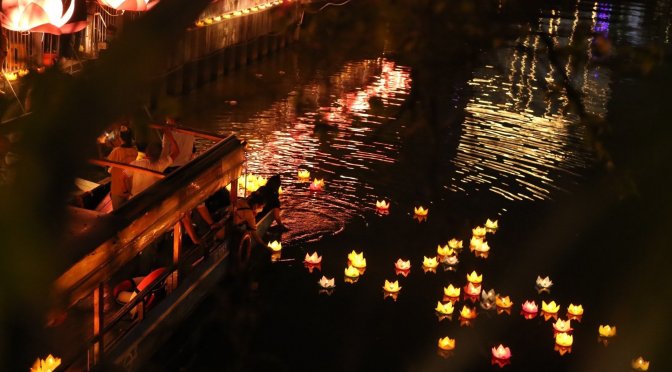
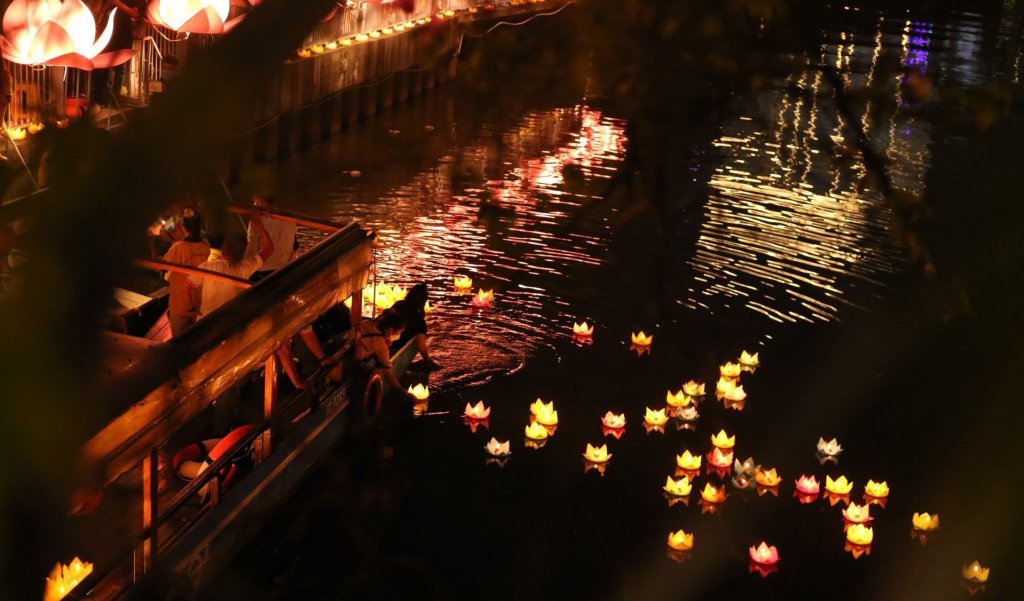
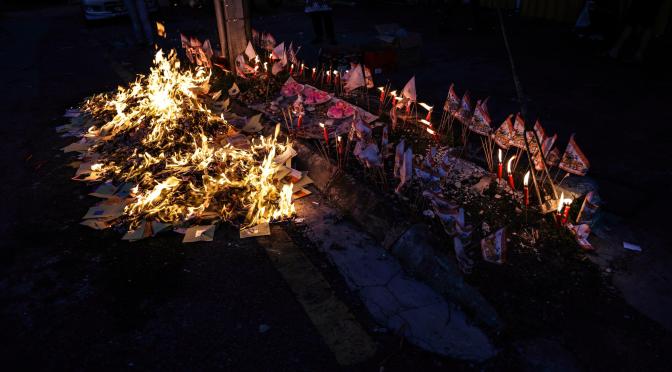
Traditionally, Taoist priests would perform chants to announce to the spirits that it was time for their return to the underworld, known as yīnjiān (陰間) or literally the “moon or hidden/shaded place”, and to drive them out from the world of the living, known in Taoism as yángjiān (陽間) or literally the “sun or open place” with the sound of their chanting. What is perhaps more familiar and common nowadays, however, is the lighting of lanterns, typically lotus-shaped, and floating them on lakes or rivers to guide those visiting spirits back to the underworld. Families will often write the names of ancestors believed to be visiting them on their lanterns to ensure they will be followed back. Many will burn further offerings fashioned out of joss paper such as money or other material possessions for ancestral spirits to take with them.

Aside from the lanterns floated explicitly for ancestral spirits, additional lanterns are made for any wandering ghosts, including those whose grievances were so strong that their souls were trapped in the world of the living, in hopes of guiding them to where they can be at peace. Despite one’s best efforts, however, some ghosts never make it back and remain in the world of the living, even well after the end of Ghost Month.

Continue reading Chinese Folklore: Lingering Ghosts Beyond Ghost Month
Chinese Folklore: The Hungry Ghost Festival

Although the month of guǐ yuè (鬼月) or Ghost Month is considered to be a highly superstitious and supernatural period overall, there are certain points in the month that are considered especially important when it comes to being mindful of the spirits believed to be freely roaming the world of the living. The foremost of which takes place on the 15th day of the month, which according to the Chinese lunar calendar takes place today, August 18th, this year. It is on this day that spiritual activity is believed to be at its peak.

This day is so significant that it is often distinguished from the rest of the month by being referred to as the “Hungry Ghost Festival” (sometimes just “Ghost Festival”), although this name is occasionally used for the entire month’s festivities.

Continue reading Chinese Folklore: The Hungry Ghost Festival

Interview: Monstrous Wives, Murderous Lovers & Dead Wet Girls (Japan Station, JapanKyo.Com)

Had a fun talk with Antonio (Tony) Vega discussing onryō (怨霊; “vengeful/wrathful ghost”) in the context of Japanese religion/folklore, theatre, as well as contemporary J-horror cinema. Feel free to give it a listen!

Tony’s podcast Japan Station is focused on discovering Japan through conversations with a guest featured on each episode. His podcast covers all aspects of Japan, including the Japanese language, history, Japanese pop culture, food, anime, manga, movies, music, comedy, the impact of Japanese culture around the world, underground social movements, social issues in Japan, and much more.

Summertime Dancing Obon in Japan

Obon, the Festival of Lanterns

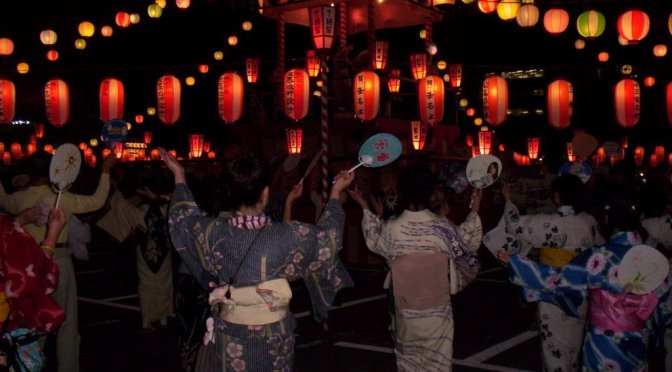
Every summer, people of all ages and religious backgrounds come together, often dressed in yukata, light cotton summer kimono, to celebrate being alive and honor those who have passed on, known as Obon.

The Obon festival, also popularly known as the “Festival of Lanterns”, is a 500-year-old tradition rooted in Japanese Buddhism belief that ancestral spirits return to their homes from the world of the dead during this particular time of year to be with their families.

Traditionally, families light lanterns to welcome and show their ancestors the way home as well as place offerings in the form of food, drinks, and flowers at their graves. l_1821271 The biggest attraction to Obon celebrations, however is the festive and family-friendly atmosphere filled with music, dance, food and good-natured fun. Usually set in the courtyards, lawns, or parking lots of Buddhist temples, families come together to savor some delicious food from the many stalls, play games, and immerse themselves in the lively rhythm of taiko drums. Continue reading Summertime Dancing Obon in Japan
PAPER: Heart of the Sword

Written in April 2009 Wrote this based on my research on Zen Buddhism and my love for samurai.

Heart of the Sword: The Relationship Between the Samurai and Zen Buddhism

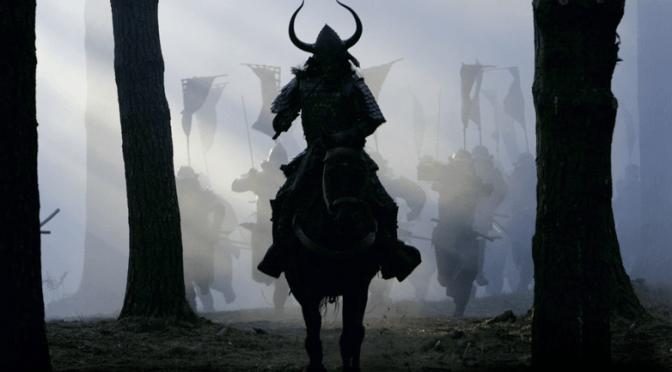
Surrounded on all sides by an emerald green bamboo grove, a figure stands silently in the center. His eyes are closed, his body poised. Leaves break free from the bamboo trees and drift down. Hearing them flutter, his eyes snap open and he draws his katana. In a flash of light, the leaves are sliced cleanly in two. One would think he is a peerless warrior; they would never guess how hard his heart pounds when he has to charge into battle on horseback. And so he is headed to where he can learn the necessary skills to turn his soul into steel as sharp his blade: a monastery. Zen Buddhism has been often referred to as the “religion” of the samurai, but upon examination it becomes apparent that the samurai’s interest in Zen comes purely from a warrior’s perspective. Despite this, the bond between them is so significant that both Zen and the samurai have been mutually influenced by their interaction, although in slightly different ways. And even centuries after the samurai’s practical need for Zen has waned, Zen is still heavily associated with the samurai and Japanese culture today. Continue reading PAPER: Heart of the Sword