秘密 ~トップ·シークレット~ – Himitsu ~Top Secret~ (Live-Action Film)

Scheduled to come out in early August, although I’m not too familiar with the original manga/anime I’m looking forward to this film.

Ikuta Toma and Rurouni Kenshin film series director Otomo Keishi have come together, along with Okada Masaki, Matsuzaka Tori, and other distinguished cast members including Kikkawa Kouji, to produce the live-action adaptation of Himitsu ~Top Secret~ (also known in English as (The Top Secret: Murder in Mind).

Continue reading 秘密 ~トップ·シークレット~ – Himitsu ~Top Secret~ (Live-Action Film)

PAPER: Borrowed Faces

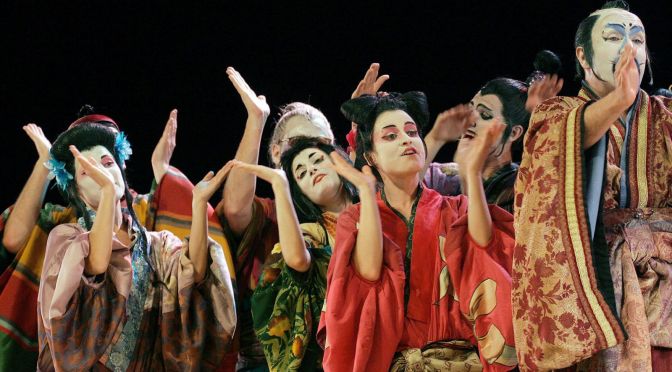
Written in May 2015 Wrote this in order to explore casting issues related to representation of Asian/Asian-American characters (and actors) in both stage and cinema, with particular attention paid to the “whitewashing” trend that has become rather prevalent in film (as well as theater) and seems to have risen out of a desire to replace the deemed more offensive “yellowface”.

Borrowed Faces: The Effect of Whitewashing Asian Roles in Theatre and Cinema

We speak of actors and then of ethnic actors, as though they were of different kinds…If someone said, ‘I saw a terrific white play last night,’ it would sound ludicrous.  Why is it acceptable the other way around?  It is time to recognize all artists as individual artists first, apart from categories that only serve to limit our imaginations.

 – Harry Newman

Though steps have been taken to move away from overtly racist practices such as “yellowface” on stage and in film, a visible lack of Asian or Asian-American representation continues to exist in both media.  When Asian or Asian-American actors are given roles, they usually maintain the same stereotypical ideology that has been dominant for decades.  But more often the presence of minority characters are “whitewashed” out of the cast entirely, a trend that has risen out of an apparent desire to replace the deemed more offensive “yellowface”.  Whether “whitewashing”, however, is indeed better and less offensive than “yellowface” is still questionable.  Although arguments in defense of “whitewashing” rationalize its existence and deny it being a discriminatory practice, it has the potential to be even more damaging than “yellowface” in terms of perpetuating stereotypical representation of Asian or Asian-Americans as well as depriving minority actors of valuable opportunity. Continue reading PAPER: Borrowed Faces

彼岸島 デラックス – Higanjima Deluxe (Live-Action Film)

I watched the serial TV drama series Higanjima during my stint in Japan 3 years ago, so I was pretty surprised to see that a continuation film is set for release October 15, complete with Shiraishi Shunya, Suzuki Ryohei, and others reprising their roles (along with some new faces).

Continue reading 彼岸島 デラックス – Higanjima Deluxe (Live-Action Film)

Summertime Dancing Obon in Japan

Obon, the Festival of Lanterns

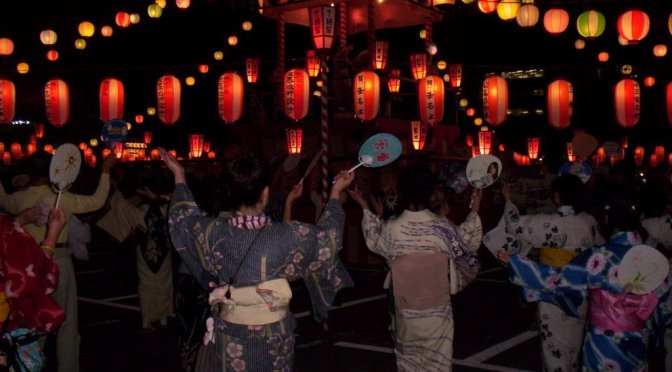
Every summer, people of all ages and religious backgrounds come together, often dressed in yukata, light cotton summer kimono, to celebrate being alive and honor those who have passed on, known as Obon.

The Obon festival, also popularly known as the “Festival of Lanterns”, is a 500-year-old tradition rooted in Japanese Buddhism belief that ancestral spirits return to their homes from the world of the dead during this particular time of year to be with their families.

Traditionally, families light lanterns to welcome and show their ancestors the way home as well as place offerings in the form of food, drinks, and flowers at their graves. l_1821271 The biggest attraction to Obon celebrations, however is the festive and family-friendly atmosphere filled with music, dance, food and good-natured fun. Usually set in the courtyards, lawns, or parking lots of Buddhist temples, families come together to savor some delicious food from the many stalls, play games, and immerse themselves in the lively rhythm of taiko drums. Continue reading Summertime Dancing Obon in Japan
PAPER: Living Wood and Still Bodies

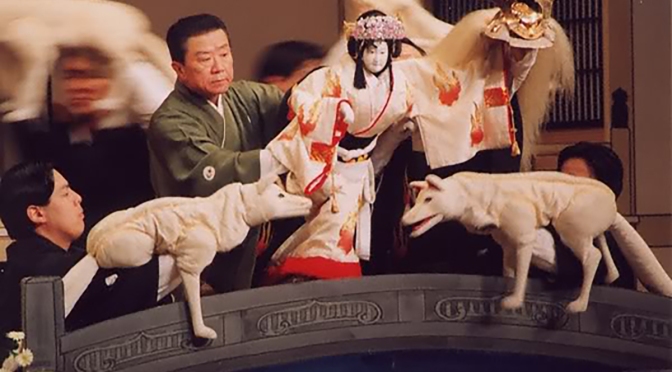
Written in December 2014 Wrote this after studying the Bunraku and Kabuki theaters, specifically the relationship of influence each theater form has (or had) on the other, from a historical, aesthetic, and performative context.

Living Wood and Still Bodies: Analyzing the Relationship Between Bunraku and Kabuki

When considering the variety of theatre the world has to offer, few have such spectacular a tradition or are as recognizable as the Kabuki and Bunraku theatres of Japan. While historically the two art forms were highly competitive with one another, scholars have argued for one art form being the more or less direct influence of the other for years. Upon studying the historical factors, visual aesthetics, and movement styles of both forms, however, it becomes apparent that discussion of this topic cannot be as clear cut and dry as some of these scholars make it out to be. Continue reading PAPER: Living Wood and Still Bodies