Tag Archives: uh manoa

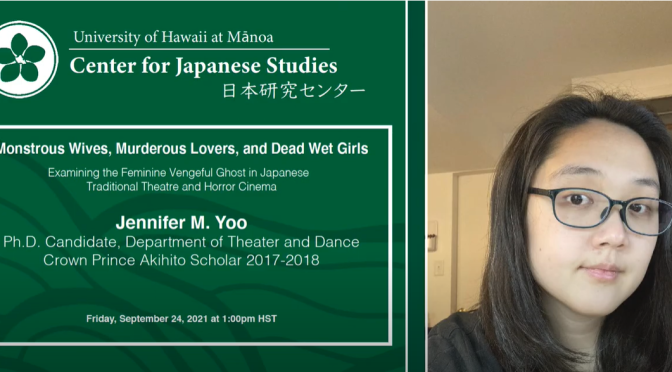
Webinar Presentation: Monstrous Wives, Murderous Lovers, and Dead Wet Girls (Center for Japanese Studies, UH Manoa)

Had the wonderful opportunity to talk and present my doctoral dissertation research as a part of the University of Hawai‘i at Mānoa’s Center for Japanese Studies (CJS) lecture series for Fall 2021.

This event was held on Zoom and was co-sponsored by CJS and the Department of Theatre and Dance at UH Mānoa. Q&A was moderated by my doctoral advisor, Professor Julie A. Iezzi.

Feel free to take a look at the replay recording of the webinar (see below) released on the Center for Japanese Studies at UH Mānoa YouTube channel!

Original Air Date of Webinar: Friday, September 24, 2021

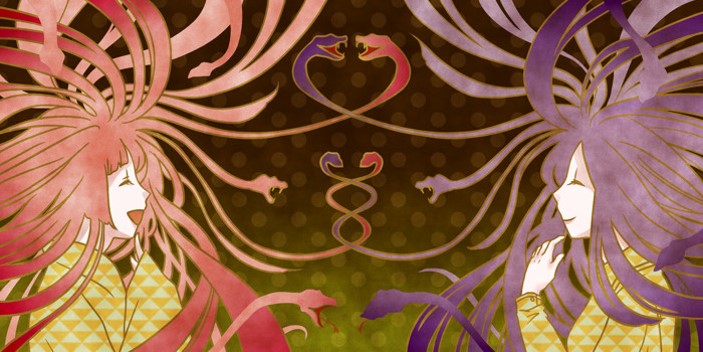
ABSTRACT: As in many cultures, woman is often portrayed as monstrous or evil by sheer fact of her being female. Today, no Japanese horror film is considered complete without its haunting woman specter, the female onryō, or “vengeful ghost” archetype. Barbara Creed’s writings on the “monstrous feminine” illustrates an innate connection of “affinity” between woman and monster as “potent threats to vulnerable male power.” Although when writing Creed was referring to Western horror cinema, the same theories can be extended to Japanese media.

By analyzing the narrative style, visual representation, and enactment of this archetype found in Japanese theatre forms and kabuki compared to Japanese horror films, it becomes apparent that the female onryō reflects views of the feminine identity in Japanese society. Contrary to the portrayal of the male, only once these women have become “monstrous” can they break free from sociocultural limitations and act on their vengeance. Their frightening and grotesque forms, however, invoke more terror and horror than sympathy, transforming the victims into the villains.

Despite the change in norms of Japanese society over time, the way these female onryō are presented remains arguably consistent, positioning them as more “monsters” and “freaks” rather than women. More significant is the tendency to associate these characters with feminine traits or behavior, thereby transforming them into something grotesque, extending the association of horror to woman herself. In so doing, the female onryō may have helped serve as a means of patriarchal control prescribing women’s behavior, perhaps explaining its continued prevalence.

Obligatory Life Update…

Life as a graduate student, graduate assistant, and teaching assistant is grueling and not glamorous.

I have successfully moved into my studio apartment. It’s nice, spacious, newly renovated and on the top floor of a four-story building with no elevator so you can imagine how much trouble my former roommate and I had getting my furniture up there.

11887987_10153676399856614_6797636383548490722_nIt gets pretty lonely in my apartment, but honestly I pretty much use the space to crash/pass out, so I’m hardly there these days.

I’m behind on my hours as a GA constantly, largely because one member of the faculty doesn’t really need me yet, and my hours as a TA don’t count. Overall though I think they are happy with how I’m doing… I hope. Most of my work is just running errands like copies, etc. I will start cataloging and digitizing video materials soon, but I’m hoping my work will expand to some research work… Continue reading Obligatory Life Update…

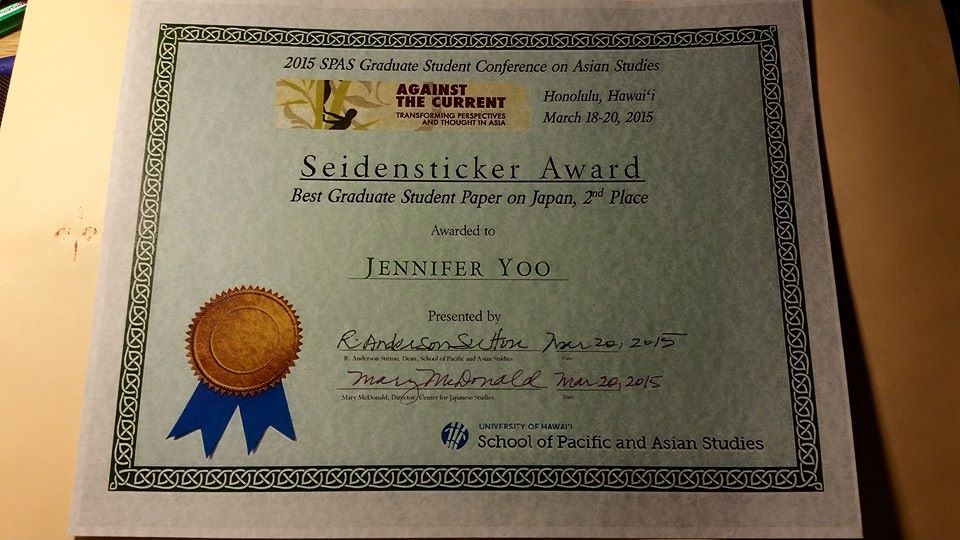
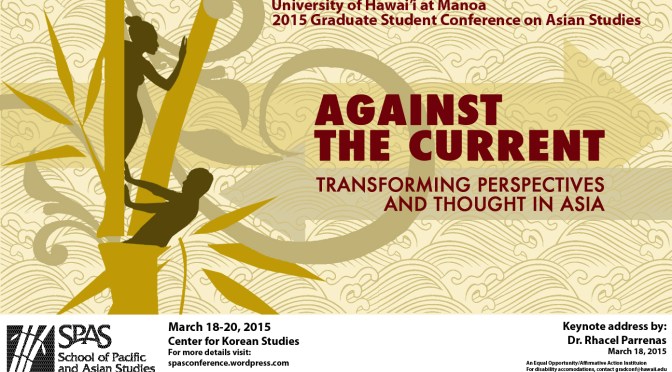
Presenting at the SPAS Graduate Student Conference

Less than one week from today I have the privilege of presenting a research paper at UH Manoa’s School of Pacific and Asian Studies (SPAS) Graduate Student Conference.  It promises to be both a great and educating experience!  Hopefully I get my presentation materials together in time @_@.

For those interested/curious, here’s the title and abstract for the paper I submitted. And if you happen to be around for the conference, please do come!

Thy Name is Woman: Performing the Feminine Ghost in Japanese Theatre and Cinema

ThyName

PAPER ABSTRACT: Noh and Kabuki are among some of the most distinctive and recognizable theatre forms worldwide. Japanese horror films are equally well-known, largely thanks to works remade for Western audiences. The significance the ghosts in these films hold for the Japanese, however, may be difficult to grasp without a deeper understanding of Japan’s close connection with the dead. By comparing and analyzing the supernatural element present in Japanese theatre forms Noh and Kabuki, it is clear that both made contributions to the image of the female ghost, specifically the onryō, or “vengeful ghost” that is so prevalent in both kaidan, traditional “strange tales”, and Japanese horror films today. Upon analyzing narrative style, visual portrayal, and performing style, it becomes apparent that the female onryō, character in theatre reflects views of the feminine identity in traditional Japanese society. These views in turn have been adapted and reinterpreted for the modern audience in Japanese cinema.