Tag Archives: 能楽

PAPER: Mishima Yukio’s “Patriotism”

Written in December 2011 Wrote this paper based on my personal interest in Mishima Yukio's works, namely his short story "Patriotism" which he later adapted for film that he wrote, directed, and starred in as the lead role and how both works express Mishima's personal ideals and beliefs.

Mishima Yukio’s “Patriotism”: Of Death, Purity, Honor, and Love

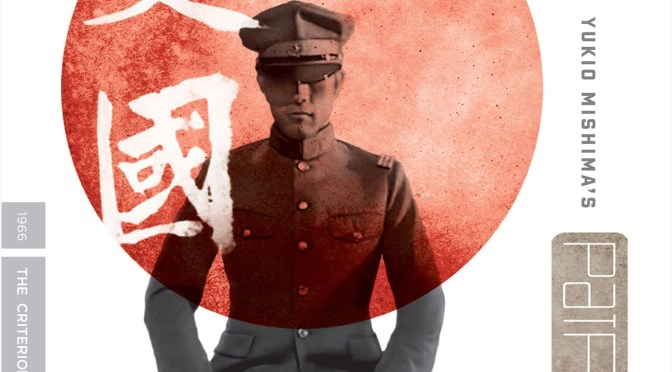
“Patriotism” is known to have been a story of personal significance to author Mishima Yukio, as he had expressed on multiple occasions how much of himself he had thrown into this particular story: “[Patriotism] embodies so many of my qualities as a writer, both the good and the bad.”  The fact that it is also the only work that Mishima handled personally when adapting it for film, as in directed, produced, wrote the screenplay, and starred in as lead actor, is testament to how important it was to him.  The film “Patriotism”, however, is not much of an adaptation in the conventional sense, and more of an expression of Mishima’s personal ideals and beliefs.  Especially in regards to Mishima’s views on the intimate relationship between death and “beauty”, which he considered synonymous with love, sex, and purity.  In both the story and the film, it is clear Mishima wanted to portray the act of seppuku as both “an act of beauty” and a purifying ritual.

Continue reading PAPER: Mishima Yukio’s “Patriotism”
Interview: Monstrous Wives, Murderous Lovers & Dead Wet Girls (Japan Station, JapanKyo.Com)

Had a fun talk with Antonio (Tony) Vega discussing onryō (怨霊; “vengeful/wrathful ghost”) in the context of Japanese religion/folklore, theatre, as well as contemporary J-horror cinema. Feel free to give it a listen!

Tony’s podcast Japan Station is focused on discovering Japan through conversations with a guest featured on each episode. His podcast covers all aspects of Japan, including the Japanese language, history, Japanese pop culture, food, anime, manga, movies, music, comedy, the impact of Japanese culture around the world, underground social movements, social issues in Japan, and much more.

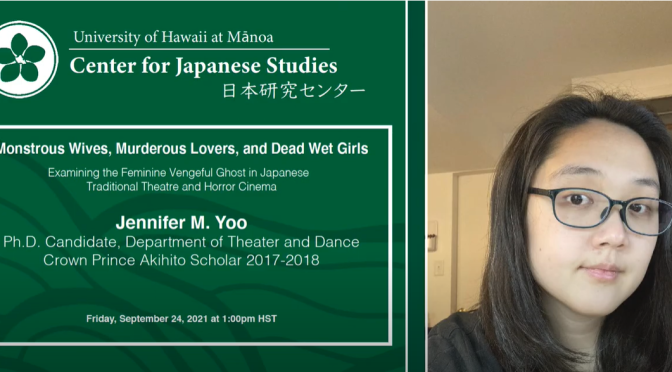
Webinar Presentation: Monstrous Wives, Murderous Lovers, and Dead Wet Girls (Center for Japanese Studies, UH Manoa)

Had the wonderful opportunity to talk and present my doctoral dissertation research as a part of the University of Hawai‘i at Mānoa’s Center for Japanese Studies (CJS) lecture series for Fall 2021.

This event was held on Zoom and was co-sponsored by CJS and the Department of Theatre and Dance at UH Mānoa. Q&A was moderated by my doctoral advisor, Professor Julie A. Iezzi.

Feel free to take a look at the replay recording of the webinar (see below) released on the Center for Japanese Studies at UH Mānoa YouTube channel!

Original Air Date of Webinar: Friday, September 24, 2021

ABSTRACT: As in many cultures, woman is often portrayed as monstrous or evil by sheer fact of her being female. Today, no Japanese horror film is considered complete without its haunting woman specter, the female onryō, or “vengeful ghost” archetype. Barbara Creed’s writings on the “monstrous feminine” illustrates an innate connection of “affinity” between woman and monster as “potent threats to vulnerable male power.” Although when writing Creed was referring to Western horror cinema, the same theories can be extended to Japanese media.

By analyzing the narrative style, visual representation, and enactment of this archetype found in Japanese theatre forms and kabuki compared to Japanese horror films, it becomes apparent that the female onryō reflects views of the feminine identity in Japanese society. Contrary to the portrayal of the male, only once these women have become “monstrous” can they break free from sociocultural limitations and act on their vengeance. Their frightening and grotesque forms, however, invoke more terror and horror than sympathy, transforming the victims into the villains.

Despite the change in norms of Japanese society over time, the way these female onryō are presented remains arguably consistent, positioning them as more “monsters” and “freaks” rather than women. More significant is the tendency to associate these characters with feminine traits or behavior, thereby transforming them into something grotesque, extending the association of horror to woman herself. In so doing, the female onryō may have helped serve as a means of patriarchal control prescribing women’s behavior, perhaps explaining its continued prevalence.

PAPER: With the Heart of a Human

Written in November 2010 Wrote this for a course I took on Japanese theater in-depth analysis of Noh styles and construction using a specific, unique play.

With the Heart of a Human: An Analysis of the Nue as the Shite

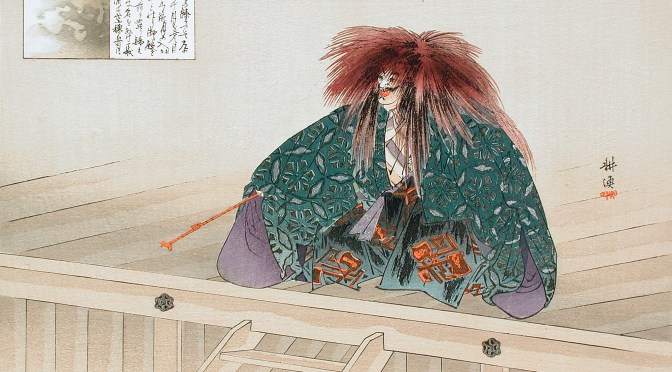
Zeami’s works are characterized by a fine lyrical sensibility, and the Noh play Nue is no exception.What is unusual, however, is that it is spoken through the mouth of a demon, the nue monster that gives the play its name. By altering the perspective and narration of the original text found in the Tale of the Heike for his Noh play adaptation Nue, Zeami effectively sets the audience up to be sympathetic toward the nue creature and allows for its emotions to become the central focus of the play. This creates a very memorable character out of the nue, which despite being a demon exhibits a certain humanness, allowing the audience to connect and empathize with the nue. Continue reading PAPER: With the Heart of a Human

PAPER: Throne of Blood Unmasked

Written in November 2009 Wrote this after studying Japanese cinema and traditional theater.  WARNING: Possible spoilers for the film!

Throne of Blood Unmasked: Shakespeare Transposed for Noh Theatre and Japan

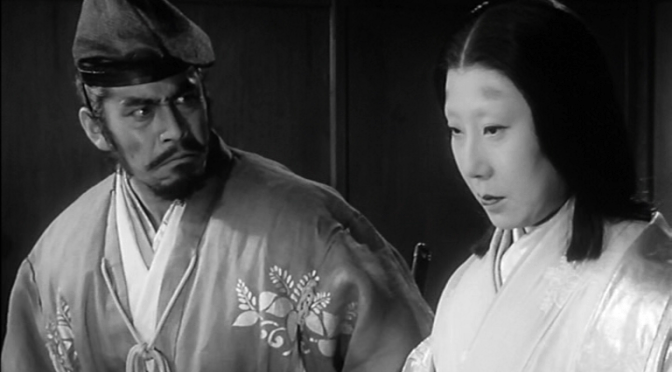
Critics commonly describe Throne of Blood as Kurosawa Akira’s adaptation of Macbeth. While this description is certainly not untrue, it hardly begins to suggest the ways in which the film is so much more than a literary adaptation. When viewed objectively, the film resembles the Shakespearean theatrical play very little. Stripped of all of its dramatic dialogue and soliloquies, Kurosawa compresses Macbeth, and replaces its elegant words with sound, stylized movements, atmosphere, and imagery of the Noh theatre. By incorporating elements of the classical Noh theatre into Throne of Blood, Kurosawa transforms the Macbeth story into something undeniably Japanese and also cinematic. Continue reading PAPER: Throne of Blood Unmasked