
Conference Paper & Research Presentations
The ‘Remaking’ of Japanese History Through Historical Fiction and Media: The Shinsengumi, the Last Group of True Samurai
Ruhlman Conference (Spring 2011, Wellesley College – Wellesley, MA)
Abstract: The memorial site for the Shinsengumi, a historical group of samurai, is visited more frequently today than 20 or so years ago. The cause is not a revived interest in Japanese history, but rather the transformed presence of samurai in popular media such as anime and television series. Ironically, popular media looks back not to history, but to the first historical novel on the Shinsengumi written in 1964 by Shiba Ryotaro. For my final project, I am translating this novel in order to understand how popular media transform the perception of Japan’s history and cultural identity
Utilized texts that had been translated for an independent study project the previous semester.
Of Flowing Sleeves and Colored Fans: Discovering Japan Through Dance
Tanner Conference (Fall 2011, Wellesley College – Wellesley, MA)
Was part of a group presentation regarding experiences studying nihon buyo and what it revealed about Japan and its culture.
Was interviewed by Lisa Scanlon for the Wellesley Magazine’s Student Feature for the Tanner Conference.
Blood and Honor: Deconstructing the Warrior in East Asian Cinema
Ruhlman Conference (Spring 2012, Wellesley College – Wellesley, MA)
Abstract: From Kurosawa Akira to Zhang Yimou, directors in East Asian cinema have been telling the story of the warrior for decades. Recent years have not only witnessed a resurgence of this film genre in China, Japan, as well as South Korea, but also a remaking of the very style that has typically been attributed to it, which results in noticeable changes in everything from cinematography to story to theme. Most importantly, however, is the portrayal of the warrior character itself in these new films. By comparing and contrasting how Japan, China (including Hong Kong), and South Korea portray and utilize the warrior in select films ranging from past to present, for my final project I will cross-analyze how changes in this genre reflect changes in each country’s society as well as the effects of interacting with Western audiences.
Utilized research conducted for an independent study film project the same semester.
Thy Name is Woman: Performing the Feminine Ghost in Japanese Theatre and Cinema
SPAS Graduate Student Conference in Asian Studies (Spring 2015, University of Hawai’i at Mānoa – Honolulu, HI)
Abstract: Noh and Kabuki are among some of the most distinctive and recognizable theatre forms worldwide. Japanese horror films are equally well-known, largely thanks to works remade for Western audiences. The significance the ghosts in these films hold for the Japanese, however, may be difficult to grasp without a deeper understanding of Japan’s close connection with the dead. By comparing and analyzing the supernatural element present in Japanese theatre forms Noh and Kabuki, it is clear that both made contributions to the image of the female ghost, specifically the onryō, or “vengeful ghost” that is so prevalent in both kaidan, traditional “strange tales”, and Japanese horror films today. Upon analyzing narrative style, visual portrayal, and performing style, it becomes apparent that the female onryō character in theatre reflects views of the feminine identity in traditional Japanese society. These views in turn have been adapted and reinterpreted for the modern audience in Japanese cinema.
Was awarded Second Prize in the Edward Seidensticker Award for best graduate student paper on Japan.
The Pursuit of Feminine Beauty in Mishima Yukio’s Modern Noh
SPAS Graduate Student Conference in Asian Studies (Spring 2017, University of Hawai’i at Mānoa – Honolulu, HI)
Abstract: Mishima Yukio (三島由紀夫) admired the Noh theatre: its formal rigor, simplicity of plot, symbolism, and extremely condensed dramatic expression. Mishima’s use of the original Noh play material, however, varies from play to play in his “modern Noh” play adaptations. Upon analyzing Mishima Yukio’s “modern Noh” plays, namely Hanjo (班女), The Damask Drum (綾の鼓), and The Lady Aoi (葵の上), it becomes evident that instead what appealed to him in Noh theatre is the fantasy of an ancient feminine beauty, which is rooted in his preoccupation with sexual complex and his longing for a hyper-idealized, old Japan. This is an image that may not necessarily be unique to his “modern Noh” plays, as it also appears in his other works, such as Patriotism (憂國).
Monstrous Wives and Murderous Lovers: Examining the Feminine Vengeful Ghost in Kaidan Literature and Japanese Theatre
ARC Seminar Series (Fall 2018, Ritsumeikan University Art Research Center – Kyoto, Japan)
Presented dissertation research as part of the 53rd ARC Seminar held on October 31, 2018.
Monstrous Wives, Murderous Lovers, and Dead Wet Girls: Examining the Feminine Vengeful Ghost and the Role of the Monstrous Feminine in Japanese Theatre and Horror Cinema
Japan Studies Association Conference (Spring 2019, Honolulu, HI)
Presented dissertation research as part of the 25th Japan Studies Association Conference held at the Hyatt Place Waikiki Beach.
Monstrous Wives and Dead Wet Girls: Examining the Vengeful Ghost in Japanese Theatre and Horror Cinema
Asian Conference on Arts and Humanities (Spring 2019, Tokyo, Japan)
Presented dissertation research as part of the Asian Conference on Arts and Humanities (ACAH) held at the Toshi Center Hotel.
Was selected as the recipient of the Stuart D.B. Picken Grant & Scholarship to present research.
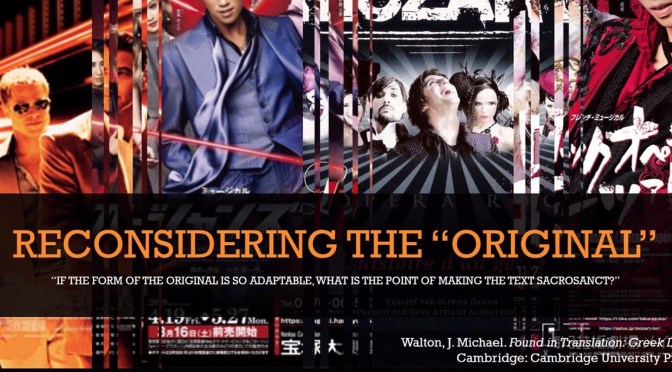
Translating the ‘Original’ in the Takarazuka Revue: Acknowledging ‘Form’ in Interpreting Adaptations for Stylized Theatre
Association for Asian Performance Annual Conference (Summer 2020, Online)
Abstract: The act of translating dramatic works is a unique creative process, resulting in an “original” theatrical text shaped by its language, culture, and form. Thus, rather than literal comprehension of the source text and language, an understanding of cultural influences and production context should be emphasized. In the case of stylized theatre, a consideration of defining elements and conventions is vital. Japan’s all-female performing Takarazuka Revue is defined by the element of stage fantasy and role-type delineations in the form of the otokoyaku (“male role” performer) and musumeyaku (“daughter role” performer), both of which heavily influence its translation of Western works for its stage. This paper shall illustrate this by close examining the Takarazuka Revue’s adaptations of select titles, including its 2008 production of Broadway musical The Scarlet Pimpernel and 2007 production of United Stages Vienna (VBW) musical Elisabeth. Through compare-contrast analysis of the “original” productions and the Takarazuka Revue’s versions, alterations to lyrics, dialogue, characterization and plot due to the theatre form’s stylized nature can be identified.
Performing Tōkaidō Yotsuya Kaidan: Adapting Kabuki for the Contemporary Audience in Japan
Association for Asian Performance Annual Conference (Summer 2021, Online)
Abstract: Playwright Tsuruya Nanboku IV dominated the early nineteenth-century kabuki in Edo, Tōkaidō Yotsuya Kaidan being one of his most notable works, which has been adapted for film over thirty times and continues to be a popular stage production today, both in Japanese contemporary and traditional theatre. Through the lens of Nanboku’s play, this paper will examine the utilization and adaptation of traditional kabuki paradigms, as well as deviation from mechanisms of the original narrative in recent contemporary productions of Tōkaidō Yotsuya Kaidan compared to “traditional” kabuki performances of the work. Although the argument can be made that these innovations have been made to better contextualize the play for today’s audience in Japan, the potential resulting effect of “rewriting” the original kabuki narrative, for better or worse, should also be considered.
Monstrous Wives, Murderous Lovers, and Dead Wet Girls: Examining the Feminine Vengeful Ghost in Japanese Traditional Theatre and Horror Cinema
Center for Japanese Studies Webinar (Fall 2021, University of Hawai’i at Mānoa – Honolulu, HI) – Link to YouTube Replay
Abstract: As in many cultures, woman is often portrayed as monstrous or evil by sheer fact of her being female. Today, no Japanese horror film is considered complete without its haunting woman specter, the female onryō, or “vengeful ghost” archetype. Barbara Creed’s writings on the “monstrous feminine” illustrates an innate connection of “affinity” between woman and monster as “potent threats to vulnerable male power.” Although when writing Creed was referring to Western horror cinema, the same theories can be extended to Japanese media.
By analyzing the narrative style, visual representation, and enactment of this archetype found in Japanese theatre forms nō and kabuki compared to Japanese horror films, it becomes apparent that the female onryō reflects views of the feminine identity in Japanese society. Contrary to the portrayal of the male, only once these women have become “monstrous” can they break free from sociocultural limitations and act on their vengeance. Their frightening and grotesque forms, however, invoke more terror and horror than sympathy, transforming the victims into the villains.
Despite the change in norms of Japanese society over time, the way these female onryō are presented remains arguably consistent, positioning them as more “monsters” and “freaks” rather than women. More significant is the tendency to associate these characters with feminine traits or behavior, thereby transforming them into something grotesque, extending the association of horror to woman herself. In so doing, the female onryō may have helped serve as a means of patriarchal control prescribing women’s behavior, perhaps explaining its continued prevalence.
Femme Grotesque: Presenting the “Monstrous” Woman in Japan’s Supernatural Cinema
Association for Asian Studies Annual Conference (Spring 2022, Honolulu, HI, Attended Virtually)
Abstract: No Japanese horror or kaidan “ghost story” film is complete without its haunting woman specter, dating back from as early as the time of film director Kurosawa Akira to as recent as the latest film of the Ringu franchise that was released in 2019. The origins in portrayal for which can in turn be traced as far back as medieval Japan. Barbara Creed’s writings on the “monstrous feminine” illustrates an innate connection or “affinity” between woman and monster as “potent threats to vulnerable male power.”
Although when writing Creed was referring to Western horror cinema, the same theories regarding the “monstrous feminine” can be extended to Japanese films. Despite the change in sociocultural norms of Japanese society over time, the way these vengeful female characters are presented remains arguably consistent, positioning them as more “monsters” and “freaks” rather than women with whom the audience can sympathize. More significant is the trend of associating these characters with feminine physical traits or behavior and transforming them into something grotesque, thereby extending the association of horror to woman herself.
Rewriting the Ghost in Kabuki: Altering the Supernatural Narrative & Performance of Kaidan-mono
Association for Asian Performance Annual Conference (Summer 2022, Detroit, MI)
Abstract: With a narrative and visual culture of ghosts, monsters, and kaidan (“strange or ghostly tales”) already rich and flourishing in Japan, it is little surprise that authors of the kabuki stage had turned to such stories for inspiration well before the turn of the nineteenth century. Certain so-called kaidan-mono (“ghost story play”) within the kabuki repertoire, especially those written by Tsuruya Nanboku IV, namely Tōkaidō Yotsuya Kaidan (“Ghost Story of Yotsuya in Tōkaidō,” 1825), have remained relatively unchanged and continue to be utilized to inspire or induce “horror” in their audiences even today.
Certain works, however, notably underwent considerable alterations to the original supernatural narrative during the twentieth century which have superseded the earlier performance traditions. Of particular note in this regard are kaidan-mono Banshū Sarayashiki (“Dish Mansion at Banshū”), first adapted for the kabuki stage in 1720 but has undergone a number of adaptations, including a complete shin-kabuki (“new kabuki”) revision in 1916, and the comparatively more contemporary play Kaidan Botan Dōrō (“Ghost Story of the Peony Lantern”), first written for kabuki in 1892, with a modern version written in 1974.
By considering alterations made to these kaidan-mono (or lack thereof in some cases), where the central ghost figure is often rewritten, sometimes removed entirely, both changes in the interests as well as social values of a modernizing Japan become apparent.
Men Making ‘Homes’: Examining (Un)Conventional Parenting & Dysfunctional Domestic Spaces in Nakashima Tetsuya’s Kuru (‘It Comes’)
Association for Asian Studies Annual Conference (Spring 2023, Boston, MA)
Abstract: Women’s struggles with motherhood and traditional marriage dynamics have often been used as a site for “horror.” The house or domestic sphere has been especially utilized as a space within which “monsters” may appear in Japanese cinema, perhaps best represented by Kayako of the Ju-on (“The Grudge”) J-horror film franchise.
In recent years, men have been encouraged to shoulder more domestic responsibilities, especially when it comes to child-rearing. In 2010, the term ikumen, a portmanteau of ikemen (“handsome/cool guy”) and ikuji (“childcare”) was introduced, and the Ministry of Health, Labor, and Welfare launched the “Ikumen Project” to encourage greater paternal involvement in domestic life. The disparity between the ikumen image propagated by the media and the actualization of the ideal, however, indicates more of a superficial change in social attitudes towards women and domestic labor.
This paper examines the 2018 film Kuru (“It Comes”) directed by Nakashima Tetsuya as a reflection and even criticism of these social values regarding both marriage and parenting. Adapted from the 2015 award-winning horror novel Bogiwan ga Kuru (“The Bogiwan Comes”) written by Sawamura Ichi, the recently married Hideki fully embodies a criticism of the ikumen, as his behavior and perception of his contributions to the household are starkly juxtaposed with that of his wife Kana’s. At the same time, while highlights the inherent hypocrisy of the ikumen phenomenon, the film also illustrates the potential horrors of domesticity, as Kana herself is contrasted with the young but infertile Makoto as a (un)conventional mother figure.
The Home That Consumes: Surreal Spaces and Realities in Miike Takashi’s Kuime (Over Your Dead Body)
European Association for Japanese Studies Annual Conference (Summer 2023, Ghent, Belgium)
Abstract: The concept of distinct boundaries is central to the construction of the “monstrous” in horror, separating the human from the non-human and bringing about a conflict between the self and that which threatens its integrity. While horror often emerges with the collapsing of those boundaries within the physical human body itself, the same can be extended to the utilization of the home as a site for “horror,” where the very walls of the architectural space are made almost immaterial, extending beyond the limits of structural form.
This paper examines the Miike Takashi’s 2014 film Kuime (“Eater Woman”), known in English by the title Over Your Dead Body, and its use of the home as more of a symbolic space for the dissolution of boundaries within a woman’s mind. As the characters within the film enter the rehearsal process for a stage production of the classic ghost story kabuki narrative Tōkaidō Yotsuya Kaidan (“Ghost Story of Yotsuya in Tōkaidō”), leading actress Miyuki prepares for her role as the vengeful female ghost Oiwa. Gradually, the boundaries of her very self begin to blend with that of the character she is meant to play, exacerbated by the actress’ own personal anxieties as a Japanese woman struggling with traditional values of motherhood and marriage. Visually this is reflected in her “home,” which is transformed into a surreal space with walls that blur with the living spaces of others, even the set of the Yotsuya Kaidan production itself. In the end, virtually all distinction dissolves as the boundaries collapse between Miyuki’s and Oiwa’s respective homes, the actor and the enacted, and between stage and reality.
From Kaidan to J-Horror: Rewriting the Ghost for Stage & Film
Japan Information & Culture Center, Embassy of Japan Lecture (Summer 2023, Washington D.C.)
Abstract: With a rich and flourishing narrative and visual culture of ghosts, monsters, and kaidan (怪談; “strange or ghostly tales”), it is of little surprise that authors of kabuki (歌舞伎; a classical form of Japanese theater) plays turned to such stories for inspiration well before the turn of the nineteenth century. These so-called kaidan-mono (怪談もの; “ghost story play”) – featuring macabre themes and terrifying stage effects – ultimately helped lay the groundwork for what is now popularly known as the “J-horror” film. As these supernatural narratives have been adapted across both medium and time – for better or worse – change has been inevitable.
In this lecture, Dr. Yoo will focus on the three greatest kaidan in Japan; namely, the stories of Oiwa from Tōkaidō Yotsuya Kaidan (東海道四谷怪談; “Ghost Story of Yotsuya in Tōkaidō”), Okiku from Banshū Sarayashiki (播州皿屋敷; “Dish Mansion at Banshū”), and Otsuyu from Kaidan Botan Dōrō (怪談牡丹灯籠; “Ghost Story of the Peony Lantern”). She will discuss how these narratives have entered the realm of Japanese popular culture through media, how they evolved, and what their changes may suggest.
Monster Cats & ‘Strange’ Women: Crossing the Boundaries of Humanity and the ‘Monstrous’ Feminine in Japanese Gothic Films
Gothic Now! Dark Atmospherics in a Post-Truth Climate Symposium (Spring 2024, Tufts University – Medford, MA)
Abstract: From as early as the nineteenth century, Japan’s fascination with the supernatural is evident in its cinema, with the first film based on a kaidan (怪談, “strange tales”) recorded in 1898. This early genre of Japanese “horror,” often referred to as kaidan films (in Japanese, occasionally “Edo gothic” in English), experienced a “boom” in production following World War II. Even when presented as the “monster,” however, these postwar kaidan films tend to equally present the “human” side of the ghosts depicted. This is most notably seen in the kaibyō (怪猫, “strange cat”) subgenre, which featured cats transforming and becoming effectively possessed by their dead (often female) masters.
The concept of distinct boundaries is central to constructing the “monstrous” in horror or gothic narratives, separating the human from the non-human. Barbara Creed’s concept of the “monstrous feminine” illustrates an “affinity” between woman and monster, representing a blurring of said boundaries. Although when writing Creed was referring to Western horror cinema, the same theories can be extended to Japanese films. By blurring the boundaries of humanity, these characters are rendered as “monstrous” while still recognizably (human) women, suggesting an intent beyond simply inducing fear in audiences.
Panel Presentations
Have been giving solo presentations related to Japanese culture and history at large anime and Japanese cultural conventions in the New England area (Massachusetts, Connecticut, New York, Vermont, and Maryland).
For detailed descriptions of the panel presentations Jennifer offers, please refer to her panel list.
- Arisia 2006 (Boston, MA) – New Panel: “True History Behind Samurai Anime”
- Anime Boston 2006 (Boston, MA) – 2 Panels; New Panel: “How to Become a Samurai in 1 Hour”
- ConnectiCon 2006 (Hartford, CT) – 3 Panels; New Panel: “Days of the Wolves of Mibu: Shinsengumi!”
- Anime Boston 2007 (Boston, MA) – 5 Panels; New Panels: “How to Become a Ninja in 1 Hour” & “Ninja: Myth Meets Reality”
- ConnectiCon 2007 (Hartford, CT) – 4 Panels
- Otakon 2007 (Baltimore, MD) – 3 Panels
- BakuretsuCon 2007 (Colchester, VT) – 2 Panels
- New York Anime Festival 2007 (New York, NY) – 1 Panel
- Anime Boston 2008 (Boston, MA) – 3 Panels
- ConnectiCon 2008 (Hartford, CT) – 4 Panels; New Panel: “Legends of the Samurai and Ninja”
- Otakon 2008 (Baltimore, MD) – 3 Panels
- Arisia 2009 (Cambridge, MA) – Contributed as Panelist to Anime Programming
- Anime Boston 2009 (Boston, MA) – 1 Panel; New Panel: “Living with Kami: Shinto”
- Otakon 2009 (Baltimore, MD) – 5 Panels; New Panel: “Women of the Floating World: Geisha and Oiran”
- ConnectiCon 2009 (Hartford, CT) – 5 Panels; New Panel: “Japanese Folklore: Kitsune, Oni and Yurei, Oh My!”
- Anime Boston 2010 (Boston, MA) – 3 Panels; New Panel: “When the Walls Start Closing In: Hikikomori and Ijime”
- Otakon 2010 (Baltimore, MD) – 3 Panels
- Arisia 2011 (Boston, MA) – Contributed as Panelist to Anime Programming
- Anime Boston 2011 (Boston, MA) – 3 Panels; Co-Panelist: “Cosplay Propmaking: Holy Crap How’d They Make That!?”
- Otakon 2011 (Baltimore, MD) – 3 Panels; Co-Panelist: “Exploring Tokyo”
- Anime Boston 2012 (Boston, MA) – 4 Panels; New Panel: “Blood and Honor: The Story of the Samurai in Japanese Cinema”
- Otakon 2012 (Baltimore, MD) – 3 Panels; New Panel: “Across the Stage: A View of Japanese Traditional Theater”
- Otakon 2015 (Baltimore, MD) – 4 Panels, 1 Workshop; New Panel: “Thy Name is Woman: Exploring the Horrors of Female Ghosts in Japan”; New Workshop: “Fans, Tricks and Hands: An Introduction to Japanese Dance Styles”
- ConnectiCon 2022 (Hartford, CT) – 4 Panels; New Panel: “From Noh to TeniMyu: A Crash Course in Anime on Stage”; Revamped Panels: “Japanese Horror: Monstrous Mothers & Dead Wet Girls” & “Japanese Folklore: Ghosts, Monsters & Strange Tales”
- ConnectiCon 2023 (Hartford, CT) – 6 Panels; New Panels: “Japanese Folklore: Yurei, Hauntings & Urban Legends,” “Shamans, Goblins, Ghosts: An Introduction to Korean Folklore” & “The Art of Fighting: Martial Arts & Violence in East Asian Cinema”; Revamped Panels: “Japanese Horror Then & Now: Monstrous Mothers & Dead Wet Girls,” “Japanese Folklore: A Field Guide to Yokai” & “Blood & Honor: The Path of the Samurai in Japanese Cinema”
- ConnectiCon 2024 (Hartford, CT) – 10 Panels; New Panels: “Anime Live-Action: The Good, The Bad, & The Weird,” “Enter the Death Game: From Battle Royale to Squid Game,” “From the Mountains and Seas: A Beginner’s Guide to Chinese Folklore,” “Japanese Folklore: A Field Guide to Yokai (Special Edition),” “Lights, Camera, Henshin: The Evolution of Kamen Rider” & “Living with the Undead: Zombies in Korean Cinema & TV”; Revamped Panels: “Japanese Folklore: A Field Guide to Yokai (Classic Edition)” & “The Art of Fighting: Martial Arts & Action in Hong Kong vs. Hollywood”
 Panda Samurai