
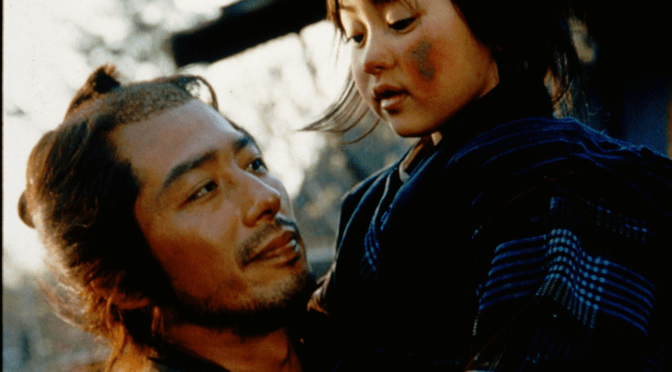
Written in December 2009 Wrote this after viewing the wonderful film "The Twilight Samurai" (directed by Yamada Yoji). Initially wrote a short review but ended up wanting to write something more in-depth. WARNING: Possible spoilers for the film!
Twilight Samurai: Born a Samurai, Live a Father, Die a Samurai
The Conflict Between Duty and Family Within Iguchi Seibei
Even to the casual viewer, it is obvious that Twilight Samurai is different from many other samurai-themed films. A clear indication of this is the fact that there are only two duel scenes in the entire film. It instead concentrates on showing the main character’s everyday struggles. Director Yamada Yoji makes his intentions regarding Twilight Samurai particularly clear in an interview, where he draws a parallel between modern Japanese workers who have devoted or sacrificed their lives for the sake of the company and samurai of the Tokugawa period. He states, “Isn’t losing one’s life fighting for the domain or for your country totally meaningless? I wanted to depict a samurai who has another basis for life.” (Muranaka 7) This is his motivation behind constructing the character “Twilight” Seibei. He is unkempt, lacks ambition, and to his associates a mockery of the samurai ideal. And yet, Yamada depicts him as a man far nobler than any other, for Seibei indeed lives for another purpose: his family. And in so doing he shows that Seibei is in fact able to accomplish, contrary to the views of others, being both a good samurai and an excellent father.
The first impression Seibei makes on the viewer is that he looks considerably dirtier than his work associates. He is not mindful of his appearance and has no hesitation about leaving right after work is finished, despite the poor impressions this leaves on his associates. However, when the audience learns that he comes home so early every night to take care of his two daughters of five and ten and his senile mother, he no longer appears slovenly. In comparison, the following scene where his fellow samurai are seen entering a teahouse, callously talking about the costs of funerals for their parents and flirting with the waitress, one wonders if Seibei really is the one who is dirty.
Yamada presents a samurai who, with a complete lack of vanity and detachment to the samurai status or image, truly moves the viewer. For example, Seibei is seen willingly taking up field work. In fact, to both the audience and Seibei himself, the farmer profession appears to be something more suited to him, for he no longer has a “stomach for killing.” And although it is later revealed that he is an incredibly skilled swordsman, he is humble and is described by others to have “no ambition at all” in terms of acquiring acclaims for himself or rising up in rank.
Throughout Twilight Samurai, Seibei stands consistently in contrast to others who are driven by ambition. After word of the storehouse incident where he offended the visiting daimyo with his odor has spread throughout the castle, Seibei’s uncle visits to express the embarrassment that Seibei has brought to the family. Wishing to make him more socially acceptable and thus redeem the family’s reputation, the uncle tells Seibei that he knows a woman who would be willing to marry him, so he should consider getting remarried. The implication is that if Seibei had a wife, he would have more time to take pride in his appearance. His uncle also expresses his embarrassment about his own senile sister, Seibei’s mother: “Whatever will the neighbors think?” Thus the uncle appears in the film as a product of the system so thoroughly engrained in society which possesses a conservative and patriarchal approach to gender roles and disregards family life. In comparison, Seibei expresses contentment throughout the film and displays a lack of desire to rise in the world. He gives priority to looking after his family, including his aging mother, and in so doing stands as a disapproving critique of both his uncle and of society.
Seibei’s lack of ambition is made particularly clear in the scene with Tomonojo on the castle grounds. Tomonojo demonstrates his concern over the political situation regarding the rising dissidence of Satsuma and Choshu samurai, who could “end the almost two-and-a-half centuries of bakufu rule with the flicker of a candle.” When Seibei is offered help finding a guard position at Kyoto by Tomonojo, Seibei declines, despite his impoverishment. Although at this point in the film the audience is not aware that he is in fact an excellent swordsman, Seibei expresses not only an extreme modesty about his own skills, but also a desire to escape from the existing social structures: “When times do change I will relinquish my samurai status and become a farmer.”
It is also interesting to note that earlier in this same scene, there are young samurai practicing artillery nearby, the firing of which pervades Seibei and Tomonojo’s conversation. However, in comparison to the evident interest of others who are watching young samurai practice, Seibei has an expression of complete disinterest, even boredom. In addition, despite the extremely loud report of the guns, Seibei stands unflinching. This not only shows his disregard for the benefits of modernization, but also the deeply rooted strength of his ideals in the face of change.
 Panda Samurai
One thought on “PAPER: Twilight Samurai”