
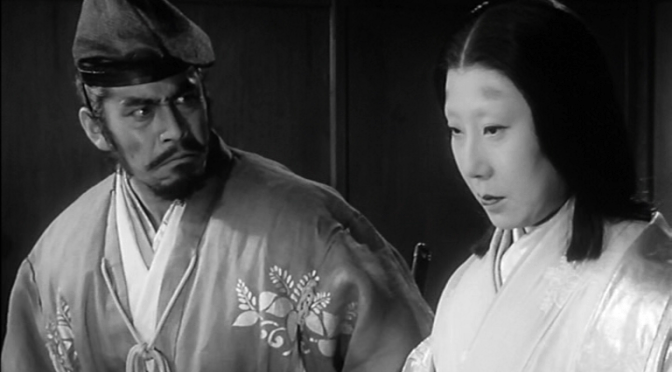
Written in November 2009 Wrote this after studying Japanese cinema and traditional theater. WARNING: Possible spoilers for the film!
Throne of Blood Unmasked: Shakespeare Transposed for Noh Theatre and Japan
Critics commonly describe Throne of Blood as Kurosawa Akira’s adaptation of Macbeth. While this description is certainly not untrue, it hardly begins to suggest the ways in which the film is so much more than a literary adaptation. When viewed objectively, the film resembles the Shakespearean theatrical play very little. Stripped of all of its dramatic dialogue and soliloquies, Kurosawa compresses Macbeth, and replaces its elegant words with sound, stylized movements, atmosphere, and imagery of the Noh theatre. By incorporating elements of the classical Noh theatre into Throne of Blood, Kurosawa transforms the Macbeth story into something undeniably Japanese and also cinematic.
Sound, or the absence of sound, produces a compelling power in Throne of Blood. In the most critical moments of the movie, such as the murder scene, it is through the manipulation of silence and the sound that Kurosawa intensifies the characters’ emotional turmoil, articulates their psychological struggle, reinforces the narrative effect that is carried out through visual images and thus recreates the dramatic power of Shakespeare’s Macbeth that was originally conveyed by dialogue.
The concentration and intensity of silence, a legacy of the pauses between chants and songs in Noh tradition, creates the compelling force of the pivotal scene in Throne of Blood. Broken only briefly by non-verbal sound and music, silence dominates the action of this scene. It deepens the dark mood of the movie, enhances the narrative effect of the visual images, and conveys the broad range of the characters’ emotional struggles from hesitation to determination, fear, and eventually terror. At the beginning of this scene, in contrast to her husband’s still position, Asaji glides around the room. Against the deep silence, the swishing sound of her silk kimono is sharp, clear, and forceful. Soon the gentle and feminine sound of silk is transformed into something ominous that the viewers as well as Washizu anticipate with apprehension. Once the drugged guards are sleeping soundly, a profound silence pervades the entire castle. The apparent silence, however, is deceiving, for soon the sharp swish is heard again. In concert with Asaji’s appearance on the porch, which can be likened to the entrance of a Noh actor on the stage, a flute can be heard. On one hand, the elegant sound forms an aesthetic harmony with Asaji’s body movement. On the other hand, it infuses a haunting sensation into the tense atmosphere. The audience then sees Washizu, again sitting intensely on the floor. The haunting sound of the flute persists, and the eerie sensation is made visual by the grotesque bloodstained walls. Asaji then enters the room and places a spear in his hand, and all is silent once again.
 Panda Samurai